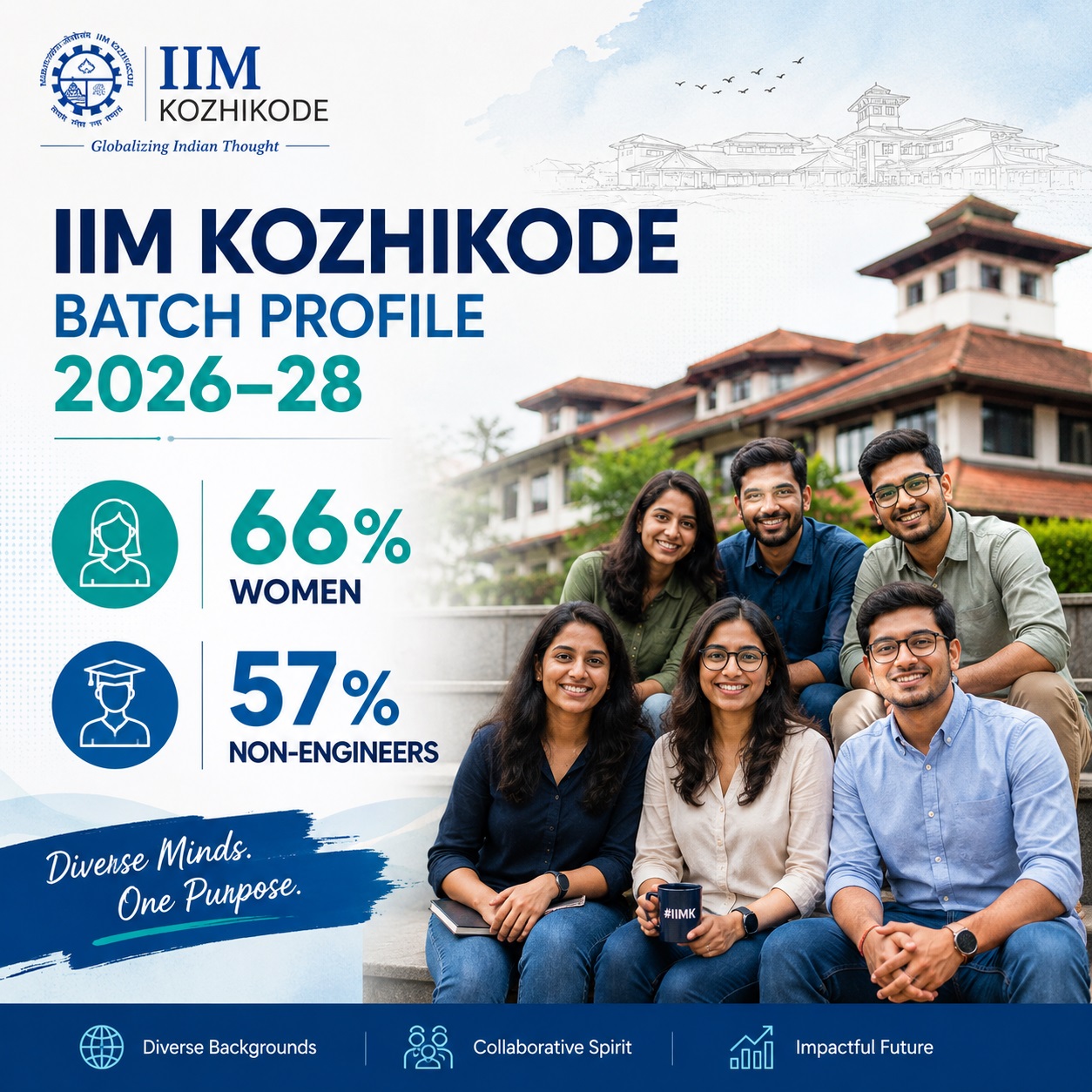
Quick Facts
- Institute: Indian Institute of Management Kozhikode (IIM-K)
- Batch: 2026–28 (30th batch of the flagship PGP)
- Total MBA intake across all programmes: 599 students
- Flagship PGP batch size: 499 students
- Women in flagship PGP: 66% (record high for any IIM flagship MBA)
- Non-engineers in flagship PGP: 57%
- Doctoral scholars admitted: 99
Programmes Covered
The induction covered students across IIM Kozhikode's three full-time MBA programmes, along with doctoral scholars:
- PGP — the flagship Post Graduate Programme in Management
- PGP-Fin — PGP in Finance
- PGP-LSM — PGP in Liberal Studies & Management
Flagship PGP Class of 2028: Batch Highlights
|
Metric
|
Figure
|
|
Batch size
|
499
|
|
Female students
|
329
|
|
Male students
|
170
|
|
Women in the batch
|
66%
|
|
Engineers
|
215
|
|
Non-engineers
|
284
|
This is the 30th batch of IIM Kozhikode's flagship PGP. Women now make up nearly two-thirds of the incoming class — the highest share ever recorded in a flagship MBA programme across the IIM system.
Academic Diversity: Non-Engineers Now Outnumber Engineers
Engineering graduates have long dominated Indian MBA classrooms, but IIM Kozhikode's latest intake shows a clear shift: 57% of the flagship PGP batch comes from non-engineering backgrounds, including commerce, economics, sciences, humanities, and law.
|
Academic background
|
Students
|
|
Non-engineers
|
284
|
|
Engineers
|
215
|
Overall MBA Intake Across All Programmes
|
Programme
|
Students
|
|
PGP
|
499
|
|
PGP-LSM
|
51
|
|
PGP-Fin
|
49
|
|
Total MBA students
|
599
|
In addition to the MBA cohort, IIM Kozhikode admitted 99 doctoral scholars this year.
Other Diversity Highlights From the 2026 Intake
- Nearly 63% women across all three full-time MBA programmes combined
- 82% women in the PGP-LSM batch
- 96% non-engineers in the PGP-LSM programme
- 87% male students in the PGP-Fin batch
- 66% women in the doctoral programmes — the highest in the institute's history
Frequently Asked Questions
How many women are in the IIM Kozhikode 2026–28 batch? Women make up 66% of the flagship PGP batch — 329 out of 499 students — the highest proportion recorded in any flagship MBA programme across the IIM system.
Do non-engineers outnumber engineers at IIM Kozhikode? Yes. Of the 499 students in the 2026–28 flagship PGP batch, 284 (57%) are non-engineers and 215 (43%) are engineers.
How many total students did IIM Kozhikode admit in 2026? IIM Kozhikode admitted 599 students across its three full-time MBA programmes (PGP, PGP-Fin, PGP-LSM), plus 99 doctoral scholars.
What does this mean for MBA aspirants? It signals that top B-schools are placing growing weight on gender and academic diversity alongside academic merit. Candidates from non-engineering backgrounds continue to gain strong representation, and IIM Kozhikode's record female intake reflects a sustained institutional push toward more inclusive classrooms.
What's Not Yet Known
IIM Kozhikode has not yet released the average age, average work experience, or industry-wise profile of the incoming batch. Based on the data available so far, the 2026–28 cohort is shaping up to be the most gender-balanced and multidisciplinary in the institute's history.