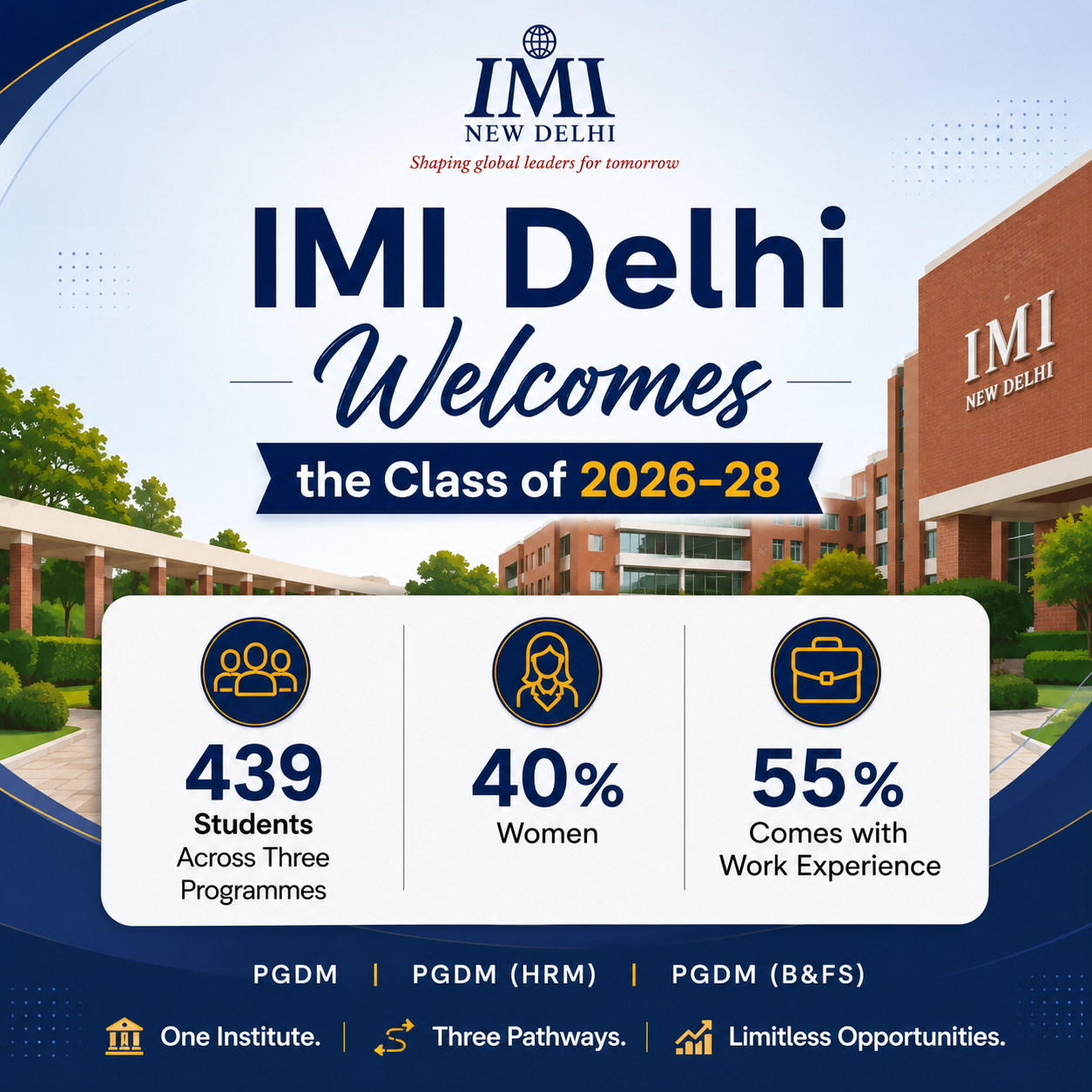
IMI Delhi has welcomed a combined incoming cohort of 439 students for the Class of 2026–28 across its three flagship two-year, full-time programmes — PGDM, PGDM (Banking & Financial Services), and PGDM (Human Resource Management). The batch brings together fresh graduates and working professionals from some of the country's most competitive academic institutions and recognised employers, with a footprint spanning 23 states and Union Territories.

A COHORT BUILT ON SCALE AND BALANCE
Of the 439 students admitted, 316 have joined the flagship PGDM programme, 61 have joined PGDM (Banking & Financial Services), and 62 have joined PGDM (Human Resource Management). Women account for 40% of the incoming cohort, a representation IMI Delhi considers meaningful gender diversity by industry standards.
On the professional-experience front, 55% of the batch brings some full-time work experience, with average tenure among this experienced group working out to 19.1 months — just under two years. IMI Delhi classifies a student as professionally experienced only once they cross a year of full-time work, a threshold designed to separate genuine industry exposure from short internship-style stints. The remainder of the cohort are fresh graduates admitted straight out of undergraduate programmes.
A PAN-INDIA CLASSROOM
Geographically, the batch draws from 23 states and Union Territories, with students joining IMI Delhi from across North, South, West and East India. Delhi and the National Capital Region form the single largest catchment, followed by Uttar Pradesh, Haryana, Maharashtra and Rajasthan among the top contributing states, with further representation from Punjab, West Bengal, Madhya Pradesh, Gujarat and Karnataka rounding out the top ten.

ACADEMIC PEDIGREE
The incoming batch includes graduates from India's premier engineering and technology institutions, among them IIT Delhi, NIT Silchar, Sardar Vallabhbhai National Institute of Technology (SVNIT) Surat, IIIT Guwahati and Birla Institute of Technology and Science (BITS), Pilani. The batch is equally strong on the commerce and liberal arts side, with graduates from Shri Ram College of Commerce (SRCC), Lady Shri Ram College, Hindu College, and Hansraj College, alongside a wider base of Delhi University colleges, Christ University Bangalore, St. Xaviers Kolkata.
BEYOND BUSINESS, BEYOND CONSULTING
The cohort reflects genuine professional diversity beyond the conventional engineering-and-commerce mix. Five students hold law degrees — LLB or BBA LLB (Hons) — from institutions including NALSAR University of Law, Symbiosis Law School, O.P. Jindal Global University, Calcutta University. Beyond law, the batch brings in pharmacy graduates (B.Pharm), two architecture graduates (B.Arch), a physiotherapy graduate (BPT), a clinical psychology graduate (B.Sc. Hons.), and three hospitality graduates (BHMCT / B.Sc.) from institutes including IHM Bangalore and IHM Pusa — a mix that adds a distinct legal, healthcare, design and hospitality lens into the classroom alongside the more traditional business and technology backgrounds.
FINANCE-READY: CERTIFIED ALONGSIDE THE PGDM
A meaningful part of the batch also arrives with formal finance and accounting certifications already underway. In all, 12 students carry an active professional certification alongside their PGDM — six are pursuing the Chartered Financial Analyst (CFA) charter at various stages, three have pursued CA, two are pursuing ACCA (the Association of Chartered Certified Accountants), and one has cleared the Company Secretary (CS) Executive programme —pairing professional certification with formal management education.
CORPORATE PEDIGREE
On the professional side, the cohort brings prior experience from some of the most recognised names in global consulting and banking, including McKinsey & Company, Goldman Sachs, and JP Morgan Chase & Co. The Big Four — Deloitte, EY, KPMG and PwC — together account for 7.5% of the incoming batch, alongside professionals from Accenture, Arcesium, Tresvista, ZS Associates, John Deere, Novo Nordisk, NASDAQ, Kantar, IBM, HCL Technologies and Amazon. The batch also includes alumni of major Indian conglomerates such as Tata Group, Reliance, ICICI and Adani Group, as well as professionals from Siemens, Genpact and Zomato
MERIT SCHOLARSHIPS WORTH ₹4.65 CRORE
IMI Delhi extended 34 merit-based scholarships (Academic excellence scholarship & Professional impact scholarship) to the incoming batch this year, together worth ₹4.65 crore. Within this pool, 11 students were awarded full, 100% merit scholarships — securing their entire tuition on the strength of academic and professional merit alone.
FPM 2026 AT A GLANCE
The FPM 2026 cohort brings together aspiring researchers with interests spanning key areas of management scholarship, including Finance & Accounting, Organisational Behaviour & Human Resource Management, Operations Management & Quantitative Methods, and Information Management. The breadth of research interests within the cohort creates opportunities for rigorous inquiry, interdisciplinary collaboration, and impactful knowledge creation.
NEEV 2026: ORIENTATION PROGRAMME
The Class of 2026–28 was formally welcomed through NEEV 2026, IMI Delhi's orientation programme, which ran from June 29 to July 11, 2026. The programme opened on June 29 with student registration and an inauguration ceremony at the Amphitheatre, featuring a welcome address by Prof. Suresh Ramanathan, CEO, IMI, and Prof. Himadri Das, Director General, IMI Delhi, along with a keynote address by chief guest Mr. Nitin Pandey, Founder & CEO of Parentune. Over the following two weeks, students went through academic preparation and industry exposure — including workshops on MS Excel, MS PowerPoint, case methodology, financial accounting, time management and communication — alongside career-track-specific industry interactions and a "Torchbearer" series featuring IMI alumni now at Google India, Genpact, Hero MotoCorp and Fidelity International, among others.
Over the next two years, the Class of 2026–28 will go through IMI Delhi's PGDM curriculum, with the batch's blend of scale, gender balance, geographic spread, and professional diversity expected to shape classroom dynamics, peer learning, and eventual placement outcomes.
BATCH PROFILE — AT A GLANCE
|
Metric
|
Figure
|
|
Total students admitted
|
439 (PGDM: 316 · B&FS: 61 · HRM: 62)
|
|
Women
|
40%
|
|
Professionally experienced
|
55% (avg. 19.1 months experience)
|
|
States & Union Territories represented
|
23
|
|
Top contributing states
|
Delhi, Uttar Pradesh, Haryana, Maharashtra, Rajasthan
|
|
Students with Law background
|
5 (NALSAR & O P Jindal Law School)
|
|
Students with active finance certification
|
12 (CFA: 6 ·/ CA: 3 · ACCA: 2 · CS: 1)
|
|
Big Four representation
|
7.5% of batch
|
|
Merit scholarships awarded
|
34, worth ₹4.65 crore
|
|
Full (100%) merit scholarships
|
11
|
|
Average Work Exp
|
19.1 Months
|
ABOUT IMI DELHI
IMI Delhi, established in 1981, was India's first corporate-sponsored business school. It offers flagship two-year, full-time PGDM programmes in General Management, Banking & Financial Services, and Human Resource Management.